What documents should aerospace buyers request? A guide to material certs, certificates of conformance and the traceability trail for flight parts.
For a machined flight part, material traceability means you can follow the part back to the heat or lot of raw material it was cut from, through every operation and inspection it passed, to the paperwork that shipped with it. If any link in that chain is missing, the part has no proven history, however good it looks on the bench.
This guide explains what that chain contains, which documents buyers should request, and how to test whether a supplier can really produce it.
Why traceability matters on flight hardware
Flight safety-critical parts are built from alloys whose properties depend on the exact lot and heat treatment. If a defect or a nonconforming material lot turns up later, traceability is what lets you find every affected part quickly instead of quarantining everything. It is also the evidence your own customer and auditors will ask for.
AS9100D, the aerospace quality standard, includes requirements for identification and traceability of products through production. Customers add their own flow-down requirements on top, so the exact expectations vary by program and should always be read from the purchase order and drawing.
The traceability trail, link by link
- Raw material. The material supplier issues a certification showing the alloy, the heat or lot number and the test results. This is the starting point of the trail.
- Receiving. The machine shop checks the paperwork against the purchase order and drawing, and records the lot against the job.
- Manufacturing operations. Each operation on the traveler or routing is signed off, so the part's path through the shop is recorded.
- Special processes. Processes such as heat treat, nital etch, hardness testing and adhesive bonding are controlled separately, with parameters and results recorded per lot.
- Inspection. In-process and final inspection results are recorded, including first-article results where they apply.
- Shipment. A certificate of conformance goes out with the parts, tying the shipped lot back to the order and its requirements.
Documents buyers should request
These are the documents most aerospace buyers ask for. Which ones apply to your order depends on the drawing, the specification and your own customer's requirements.
- Material certification: shows the alloy, heat or lot number and test results from the material source. Ask for it on every order that specifies a material.
- Certificate of conformance: states that the shipped parts meet the drawing, specification and purchase order. Ask for it with every shipment.
- Special process records: process parameters and results for each lot, for example hardness, nital etch, conductivity or bonding. Ask for them on any part with a special process on the drawing.
- First-article inspection report: shows the production process produces conforming parts, measured against every drawing characteristic. Ask for it on new parts and revisions.
- Inspection records: dimensional and visual results for the lot. Ask for them when the drawing or contract calls for them.
- Calibration traceability: shows measurements trace to a national standard such as NIST. Ask for it during audits and supplier surveys.
Write these into the RFQ so the supplier prices them. Our aerospace RFQ checklist covers what else to include.
How to test a supplier's traceability
Do not rely on a procedure document. Pick a part the supplier has already shipped and ask them to produce the whole trail: material certification, the routing with each operation signed off, the special process records, the inspection results and the certificate of conformance. How quickly and completely they can do it tells you more than any quality manual. We describe this and seven other checks in How to Evaluate an Aerospace Machining Supplier.
Watch for these warning signs:
- Material certifications that arrive late or cannot be matched to a lot number on the part.
- A certificate of conformance that is generic and does not reference the order or revision.
- Special process results that exist only as a pass or fail, with no recorded parameters.
- Calibration records that cannot be traced to a recognised standard.
How TEK Precision handles traceability
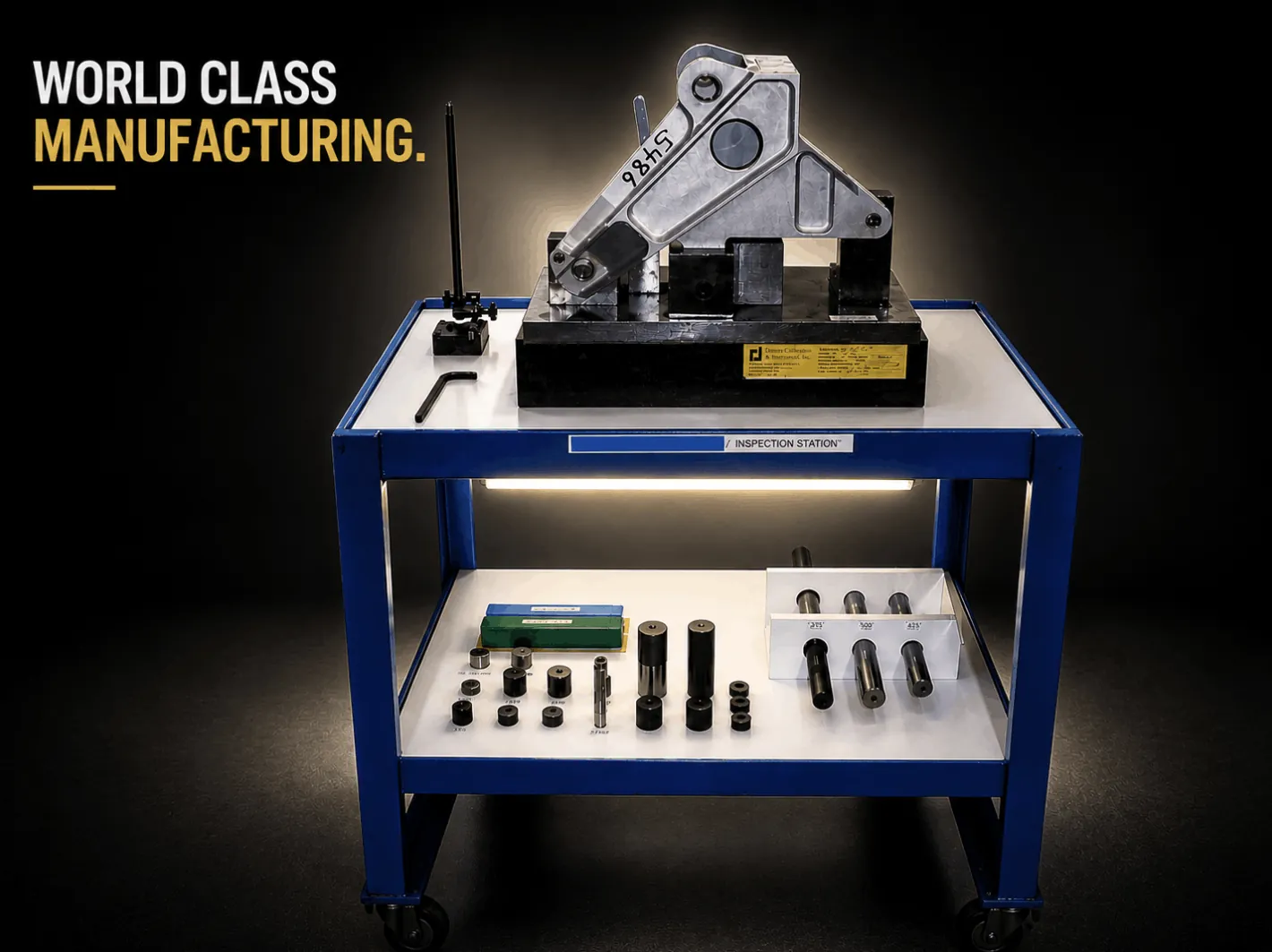
TEK Precision is AS9100D and ISO 9001:2015 certified (certificate no. 275724, issued by Amtivo (USA) Inc. under ANAB). Our quality organization has independent authority over inspection, calibration and supplier surveillance. Our in-house inspection lab covers CMM, hardness, surface, thread and dimensional verification, and our calibration is traceable to NIST.
Every lot we ship is tracked from raw material through final inspection, with material certification tied to the heat or lot, so a part can be traced back to the stock it was made from. On new part numbers we perform 100% first-article inspection to the AS9102 format, and the first-article package includes material certification and special process certifications. Hydraulic assemblies ship with their full test data attached.
For structural adhesive bonding, we are qualified for all classes of Sikorsky SS8669 with full traceability per Sikorsky SSQR, and we carry out tensile and etch verification in-house. Our approved special processes also include nital etch inspection, hardness testing, stress relieving, tensile testing and conductivity inspection.
Procurement teams can request audit documentation or schedule a facility quality audit through our contact page. You can see our quality credentials and approvals before you do.
Frequently asked questions
What is the difference between a material certification and a certificate of conformance? A material certification comes from the material source and reports the alloy, lot and test results. A certificate of conformance comes from the manufacturer of the part and states that the shipped parts meet the order requirements.
Is a certificate of conformance enough on its own? Usually not. It is a statement, not evidence. Buyers typically want the supporting records behind it, which is why audits trace a job from material to shipment.
What should an RFQ say about traceability? Name the documents you need with each shipment, such as material certifications, a certificate of conformance and special process records, and state any customer flow-down requirements.
How is traceability related to first-article inspection? First-article inspection shows the process can produce conforming parts. Traceability shows that every later part came from that same controlled process and a known material lot. See our guide to first-article inspection.
How do I audit a supplier's traceability? Pick a completed job and ask for the complete trail, from material certification through each operation and inspection to the certificate of conformance.
Related capabilities: Inspection and test equipment · Machining capabilities · Aerospace parts catalog